
Anchor the risk. Create asymmetry on your trades.
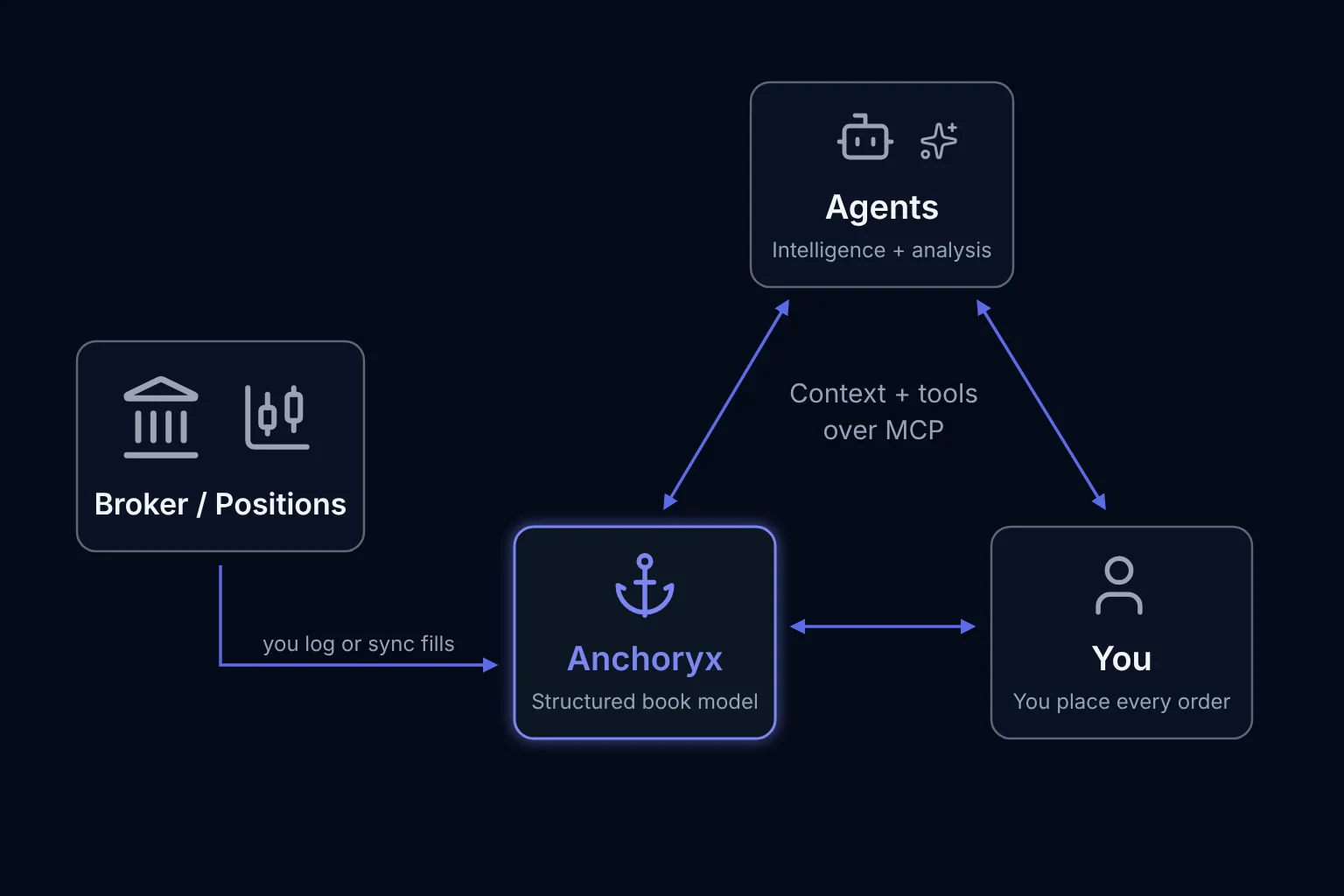
Write each idea's target, invalidation and risk before you enter. Anchoryx keeps that plan, sizes the trade against its stop, tracks the open risk across your whole book, and serves all of it to your AI agent over MCP. You make every call.
Built by traders managing their own capital · Works with Claude over MCP
Access is by request. We review each request within about a day.
Your broker shows the what. Anchoryx remembers the why.
An LLM with positions but no thesis will confidently rationalize your worst trades.
The structured layer between your book and your model. You stay in control.
See the difference
Same question to your agent — with and without the brain layer. Illustrative example.
Wherever you are on the LLM curve.
Three levels of LLM adoption. One workspace that grows with you.
Track the book. Extract the insight.
“I want my book legible — to me first.”
You research and trade by hand. Anchoryx holds the positions, theses and hedges you log in one structured workspace, and shows the open risk, the plan and the history behind each one.
Stop pasting your book into Claude.
“I want my agent to actually know my positions.”
Capture theses, scenarios, trades, and risk in Anchoryx. Your LLM reads the same structured book over MCP — no more screenshots, no more rebuilding context every chat.
Run the agent. Anchor the process.
“I want the agent doing the legwork, inside my rules.”
Your LLM runs discovery and drafts plans over MCP, against the same rules the desk computes in code. It reads and proposes; you place every order.
One workspace. Every level.
Whether you're reasoning solo, pairing with an LLM, or running an agent-led book, Anchoryx is the same structured source of truth — the anchor that keeps process, positions, and decisions tied together as your workflow evolves.
Sizing positions against a book? See how Anchoryx works as trading risk management software.

What you get on day one.
Request access, we review it within about a day, and your desk is ready to use.
Included with your account
- Trade plans (anchors): thesis, entry, target, invalidation and size, written before you commit capital.
- Stories, and Story Craft idea scans (in testing; off until you turn them on; run on your own Anthropic API key), each idea scored on reward to risk from its own levels.
- The risk book: total open risk, a stress test net of hedges against a loss budget, exposure vs NAV, and hedge coverage.
- The allocation read: strategy sleeves budgeted in capital at risk, a bias band, and a theme cap in test mode (it reports; it doesn't block yet).
- The weekly check-in and report card.
- The Anchoryx connector for Claude.ai, so your agent reads the same book you do.
How we run our own desk
We run always-on scheduled agents on our own Claude account: a desk agent that prepares each session and follows up on its own deadlines, plus agents that watch the machinery, build and test changes. Those are how we operate, not part of the product.
See the example desk